Biobased

In Broeinest, the place where I’m doing my internship, we have a permanent exhibition of ‘Materia‘. It is the global network in the area of innovative materials and every four months the theme off the exhibition changes. From January till April the theme off the exhibition was called ‘Biobased’. I wanted to get to know more about the various projects based on this theme and I want to share my selection of projects that caught my attention!

People use different meanings off the term ‘Biobased’. One of the explanations could be: ‘Derived from living organisms, both plant and animal, biobased materials feature a low CO2 footprint, low energy costs and generate no – or minimal – pollution. Examples include bioplastics, compostable materials, fungi and algae as a new raw material, ‘waste’ materials such as coffee grounds and nut shells or chitin from shrimp shells, and new materials made from wool, leather, hemp and nettles. The source of raw, biobased materials available is inexhaustible. Residual materials from the agriculture and forestry sectors also offer economically interesting material inspiration’ (Materia).

47_studio-thomas-vaillyreconfiguration-of-a-tree-21

Studio Thomas Vaily – Reconfiguration of a tree
by David Derksen, Thomas Vaily, Gardar Eiolfsson & Lex Pott

The project of Thomas Vaily, ‘reconfiguration of a tree’, is a proposal to go back (return) to the basics and to develop new materials with natural building blocks. With this project, Thomas Vaily, is examing the pinus pinaster, a resinous tree that was cut down for the production of pitch.

Because of the wide range of synthetic alternatives for resin, the harvesting of resin has become a vanishing industry.

To re-examine the production system, studio Thomas Vaily focuses itself mainly on the qualities of the material. In this way, not only the tree, but all the parts of the pinus pinaster have been used to transform it into a black substance with completely new properties.

Then, four designers have been asked to create new objects with resin and wood.

47_studio-thomas-vaillyreconfiguration-of-a-tree-22

47_studio-thomas-vaillyreconfiguration-of-a-tree-23Studio Thomas Vaily
Gardar Eyjólfsson


Lex Pott & David Derksen


Marlene Huissoud – Of insects & Men

25_Credits_Studio-Immatters-1024x683

Marlene Huissoud is a French material designer who comes from a family of beekeepers. She is ‘interested in the viability of utilising insects and their wase streams to create future craft artefacts'(M, Huissoud).

Insects & Men explores the beauty of honeybee bio resin. Her new piece has been shown on Salone del Mobile in Milan at La Terrace. Her stunning new piece continues her exploration of bio resin, the material produced by the honey bee as waste, but now combining it with commonly discarded human glass waste. The pieces question the idea of how two waste materials, natural and industrial can complement each other (given an up-cycling approach)
The honeybee ressin is used to bind the glass pieces together in those sculptural ‘alien look’ pieces.

‘It is questioning and underlying the way of how we use materials nowadays and in the future’ (Domusweb).


Fruit Leather

http---mashable.com-wp-content-uploads-2015-08-fruitleather-003

Designers from Willem de Kooning have been asked to design something to prevent food waste. They discovered that on a market near/close to the academy, more than 3,500 kilos of unmarketable fruits and vegetables remain everyday. They decided to use these products to create leather. ‘Food isn’t trash, you just need to find a different purpose for the existing material’ they said.

‘What we want to achieve with this project is to create awareness of the problem of food waste and show that there is a solution’.

By using the name ‘Fruit leather Rotterdam‘, the designers are experiencing with the material. Back in the days the technique has been used to produce candy and snacks (still). And now they have already created a bag made of mango’s!

91d4ea_bac481a57d5c477ebf67b79eb9e92a7dhttp---mashable.com-wp-content-uploads-2015-08-fruitleather-001

Mandy den Elzen – Goat stomach Leather

goat-stomach-leather-ona560-3-960x640.jpg

Mandy den Elzen is a visual artist who approaches materials with a scientific and meticulous approach. Working with special left-over animal parts, den Elzen looks to expand the number of animal parts that can be tanned an used for leather, thus making better use of available resources.

With her work ‘The Equine Digestive System’, Mandy den Elzen continues her extensive research into the process of making leather from animal organs. She has worked with cow stomachs and now with goat stomachs as well. The stomachs of herbivorous animals especially, have beautiful structures. Possible applications include fashion and accesoires (Materia).

Her work questions’ society’s attitudes towards the use of animal parts in our everyday world and within the leather production industry in particular.

Mandy_den_Elzen_Rumen.jpg


MONO SHOPS

11157519_944038178963385_7991833305860491710_o-2

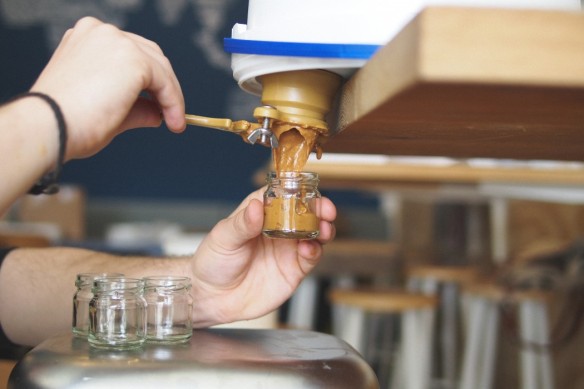
After the flagship stores, more and more mono stores have been opened in  the Netherlands. These are super specialty retailers that specialize in only one product. For example there is a ‘pepernoten’ shop offering ‘pepernoten’ in fifty different flavors. Meanwhile, there are also peanutbutter-, nutella-, popcorn-, duo penotti-, macarons-, omeletfries-, stores and hamburger bars.

Back in the days, there were no super specialty stores. There is a difference between the super speciality stores and for instance the butcher, the greengrocer or the bakery. For a mono- store, the greengrocer can for instance only sell apples, the baker only bread and the butcher only sausages. If you compare the old greengrocer with a supermarket, it is a specialist but not THE specialist (lbbrhzn).

Over the years, have slowly been replaced by the big chain stores where consumers could find different product groups under one roof. But the subsidiarisation of the shopping streets is declining for the first time in years and that gives more space to the independent retailers.

Most mono-stores nowadays are from small entrepeneurs,  but it actually began as a way for big companies to become more visible and gain customer loyalty. In today’s society, there is an increasing demand for perception and service. Because they only offer one product in endless variations, it is unique and not available anywhere else. A mono store can respond quickly to the changing market conditions especially those from its specialization.

P4170557-3-1050x700

These single-product companies mainly arise in Amsterdam. Retail expert Cor Molenaas sees Amsterdam as an ‘internatiol display of a shop’. And he thinks it’s fun for tourists, but not efficiënt for the residents in Amsterdam.

Food watcher Anneke Ammerlaan notes that ‘we want to move away from the standard. We will choose the creative and thereby we are drawn to the cuddly, accessible products like peanut butter and chocolate’, she says.


what to do with the water

Mobiele-Dijk-Pieter-Verbeek-1.jpg

In the Netherlands we have been living below sea level for over 800 years, so I think we can say that we are experts when it comes to the defense of water. With the climate change and the increase of large weather fluctuations it’s necessary to experiment with new flood protection solutions.

Those who want to win the battle against flooding, can’t leave it to a coïncidence. Meteorologists worldwide have agreed already for times: disaster floods, sometimes with devastating consequences for residential areas or wildlife, are becoming more common. Effective flood protection is therefore essential. Mobiele Dijken is a new take on flood protection solutions. With Mobile dikes there is a new, highly efficient system designed, and already tested many times. With the help of Mobile Dikes a temporary barrier can be realized in a very short time and with no additional equipment or heavy machinery with a maximum height of 2.6 meters.

CYtrpwVWYAAFUmm.jpg-large.jpeg

How do you fight against water? Well, with water. The mobile dikes of fireman Dirk Bon and Sailmaker Bart Viscount, are created with sail and filled with water. In case of emergencies they have built a temporary dam within a few hours.  There is no need for sandbags anymore. Their innovative idea earned them a spot in the final of the Challenge City.

Climate-resistant constructing, designing, housing and living asks for a change in thinking and doing. It requires governments for example, to deal with the design of public spaces differently. To arrange the climate-proof cities they should work together with other parties. City deals, alliances between cities, state and other stakeholders can make a contribution  by experimenting with issues such as climate change adaption. The mobile dikes are a good example of this.

CPBECpFUcAA4FeJ.jpg-large.jpeg


Sources:

http://popupcity.net/mobile-dikes-protect-the-dutch-against-floods/

Mobiele Dijken-Stop water met water


http://www.mobieledijken.nl/mobiele-dijken


Transformation of the inner beauty

Body of Matter - Hanneke Wetzer-41

Hanneke Wetzer


Isaac Monté is a design activist and designs objects and installations as a response to the social, ecological or economic problems. At the moment his work called ‘the art of deception’ is been featured in Kazarne, Eindhoven during the exhibition of guest curator Jeroen Junte, called ‘next up’.

KazerneExpo_NextUpByJeroenJunte_h-r_IsaacMonte_AlikivanderKruijs.jpg

Ruud Balk


‘We have taken discarded pig hearts and transformed them into elegant vessels for new life by decellularizing them and re-populating them with various techniques, into aesthetically improved hearts for humans’ (Monte).

The work consists of 21 cylinders, each containing a transformed porcine heart. With this collection, Aterlier Monté, explores how biological intervention and aesthetic manipulation can be used as tools for the ultimate deception: transforming the inner beauty, from extreme to perfect. Isaac thereby asks the question on how muslims and vegetarians respond to receiving a donor heart.

medium-dsc09075-bewerkt

Isaac Monte

The project is about improving and beautify the human body, it is about the deceptiveness  of beauty and the scientific developments in the field of tissue culture and organ transplantation. Isaac examines the future scenario in which the scientific improvement of an organ such as the heart does not result from medical necessity, but out of greed and coquetry.

You could see Monte as an explorer in a possible future world. His findings ask fundamental questions. What does it mean that our body, the most familiar, that is composed of material that we can analyze and manipulate as desired? What does it say about our identity? Does it exist independently from our bodies? In other words, what is humanity?


Patternity in Vilnius

As I already mentioned in one of my previous blogs I went on erasmus exchange to Vilnius for one semester. After spending the first weeks as an tourist checking out all the famous places. I started to perceive Vilnius in a different way.

I am an perfectionist and I always look at details, patterns and behaviors of people. In the Netherlands I study International lifestyle studies and one of the core subjects is trend watching, we also call it ‘Coolhunting’ (hunting for cool things). ‘It’s about looking at the world around us with the aim of mapping current changes in the society and see patterns in small or big things and trying to explore the shifts in the environment.

So I started to capture Vilnius from a different perspective, in patterns, and I made a fanzine about it, with 4 different patterns.

‘‘Pattern is everywhere we go and in everything we do. We wear patterns, we walk over them, we even eat, drink and think them. From fashion and design to the natural world, look beyond the mundane forms that we see everyday to find the hidden beauty in the underlying patterns that normally pass us by’’.

1. GARAGE TOWNS

Between the grey buildings outside the Old town of Vilnius you can see hidden pieces of colors, the old ‘Garage towns’, vast Soviet designed areas for storing cars. None of the doors is identical, the doors always symbolize the other life, the other choice. Some doors can tell a lot about people and some of them don’t. It triggers your imagination, who is the owner of this door, what is behind the door?

‘‘Finding patterns can be a way to appreciate the random,
unprogrammed beauty of the world’’.

green doors

grey doors

graffiti doors

‘‘Not answerring to the newness of things but rather focusing on the chemistry between the old and the new, patternity proves there is inspiration in every corner of our surroundings’’.

2. BIRDS OF VILNIUS

These Pelicans are spread troughout the whole city, it gives you an exciting feeling to discover new pieces of the graffiti and you start wondering who is behind all this work. And what the meaning is of this work? It creates smiles on people’s face and at the same time it makes people annoyed.

pelikanen.jpg

3. LIETUVOUS SPAUDA

A striking phenomen in everyday street of Vilnius are little kiosks. If you are lucky you will discover the beauty of these kiosks.

kiosks2.jpg

‘‘There are only patterns, patterns on top of patterns, patterns that affect other patterns. Patterns hidden by patterns. Patterns within patterns. If you watch close, history does nothing but repeat itself. What we call chaos is just patterns we haven’t recognized yet. What we call random is just patterns we can’t decipher. What we can’t understand we call nonsense what we can’t read we call gabberish. 

There is no free will.
There are no variables’’.
– Chuck palahnuik. 

kiosks3

4. HUMANA

yellow,yellow,yellow

‘‘Not answering to the newness of things but rather focusing on the chemistry between the old and the new, patternity proves there is inspiration in every corner of our surroundings’’.

humana.jpg


This bike has multiple sclerosis

this-bike-has-ms-ep


Multiple Scleroris (MS) is an onnoying disease. It is common to have several symptoms and it is very difficult to explain the disease to people, and to explain how it effects your body. Grey invented a cool idea: in collaboration with neurologists, physiotherapists, patients and bicycle repairers they incorporated the virous symptoms of the disease in a bicycle. So now everyone can feel exactly what it’s like to have MS.

Broken gears, wheels and brakes, it’s all on the bicyle. If you have used the bike for 20 minutes it becomes clear that you are using certain muscle groups that you’ve never used before. And it is very clear that the human body acts like a machine; also machines are able to get terrible short circuits and MS is perhaps the best example for that.


Social Campaigns

jantjebeton

(Jantje Beton)

Do you remember the times when you went from door to door to sell lottery tickets for your sports club? I always skipped some houses from which I knew that they would slam the door in front of my face or never donate money and at others I found it fun to go to because of the piece of candy I often got there. My parents are both collectors and once a year they go from door to door to raise money for the ‘dutch heart foundation’ and the ‘skin burn foundation’.  They note that less donations have been given every year, probably because of de reduce of small money that people keep in their pockets.|
I irritate myself often for students who come to the doors or waiting in front of train stations to raise money, they work for big companies such as ‘pepper minds’ and make lots of money with it, while they exchange charities everytime they have to work. I never get the impression as if they really stand behind the charity. I usually end up by writing my bankaccount because I think it’s difficult to say no. But it’s simply not possible to support every charity and that’s why I only want to support foundations which I consider as important. Persuade people to donate money would never by my cup of tea.

I think it’s important to create awareness and to anticipate on social control. You have to face them with social problems, create the guiltiness and the way of approach has a major impact. Once people are unpleasant or won’t tell a good story I will donate less. Another thing, it should be easy for people to donate. And finally we usually would like something in return if we donate, like a gift, or to show others that you are doing a good job and to have a better karma. I want to share some social campaigns with you from which I think they have a good approach.

WaterAidCrop-20160125114222568

Hope Locker

When you go swimming, you probably should always have a coin with you for the lockers. And you will always get it back at the end. But now you can also omit the coin.

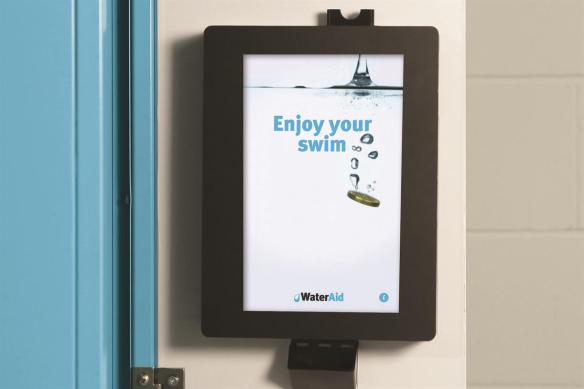
For example Agency Proximity Londen came with a new Idea. For their charitable customer WaterAid, they wanted to create awareness and obtain donations. To make the goal relevant to the audience and create a donation option, the agency put the focus on the swimming and fitness industry. A place where people are constantly using water; they swim in it. Therefor she developed, together with MediaMonks, the Hope Locker.

The Hope Locker is a locker just like any other in gyms or pools. Here, you also insert a coin to safely store your clothes. However, this system has been made more interactive and sets in a message after your swim. The report responds to the amout of water you’ve swallowed, it’s probably an experience you’d rather forget if it’s happened to you. ‘But it might just make you think about what life is like when you have no choice about the water you drink – which is were the Hope Locker comes from’ (Wateraid). The report will ask you at the end if you’d like to donate it to WaterAid.

Because of the small amount everytime and the and the guilt that they generate, people will donate faster.


A table to end hunger

In Australia, an organization has started with a clever charitable concept. In Australia it’s in the weekends almost impossible to book a table at a restaurant, simply because the demand is too great. Not a first world problem to mention when compared with the 795 million people that are suffering from hunger around the world. Therefore McCann Sydney came with ‘A table to End Hunger’. A concept in collaboration with E-bay where tables were auctioned among interested parties. All proceeds from the auction will be donated to banish the hunger in the world by 2030.


MEANS online food bank

MEANS was started with the blief it should be easy for those with excess food to share it with those in need. It didn’t take long to find people who agreed.

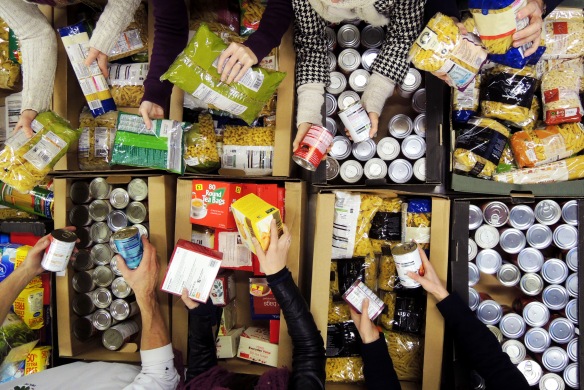
MEANS is a web-based, searchable database that lets member food pantries and suppliers share information about whether they need specific products or have an excess of products so that pantries can make better use of resources and avoid waste.’They are now in 42 states and counting, helping divert food from the trash to local emergency feeding services with the ease and speed of the internet’ (MEANS).

MEANS works as following; the donors can simply post what food they want to donate to instanly connect with food distributors in their area and the food banks and pantries get real-time notifications on food donations and can claim what works for them. If they can’t pick up something or don’t won’t it they can just ignore the alert.

foodbanksorting


Scars with a touch of gold

HG-Cicatrices-150513-Marie-06

Artist, Hélène Gugenheim makes scars sparkle with gold leaf. A few months ago the French artist met a woman. When she had to change clothes for the occassion, Guggenheim notcied that this woman had a huge scar on the spot where first her left breast had been.

This was the start of the project ‘Mes cicatrices, Je suis d’elles, entièrement tissé (my scars, I am completely interwined with them). In a series of photos and video performances the scars of participants had been painted in a subtle manner with gold leaf.

We all bear scars, on our body or invisible to the eye, but showing through our behaviours. They come from appendicitis, broken heart, injustice, mastectomy, accident… (Gugenheim). 

HG-150515-Olivier-3.jpg

Each scar tells a story of which we are the hero. A scar is the mark of a wound. But it is also the vibrant proof of the healing process, the sign that we have come to terms with a traumatic experience. A wound separates us from our former self and disrupts the course of our life. The healing process enables us to recreate a functional entity – but an entity that is not a return to our previous state, because the wound has changed it forever. The scar is therefore a witness of our reconstruction and the sign of our capacity to adapt, to reinvent ourselves and even mutate. In this respect, we are all gods (Gugenheim). 

HG-150515-Olivier-6

HG-050516-Clementine-8

Gugenheim was inspired by the principle of Kintsugi, this is a Japanese art form in which broken pottery is glued with a mixture of gold and epoxy in which the fracture will be visible. It makes the original plate or teacup even more beautiful; imperfections become a sign of beauty.

Like the broken ceramics, scars will be a sign of strength and life, rather than a painful memory. Afterwards the gold will be removed and dissolved in a pot of alcohol as a permanent memory of this moment.

golden scars.jpg


Source: 
http://helenegugenheim.com/?cat=1
http://www.paradijsvogelsmagazine.nl/kunstenares-laat-littekens-schitteren-met-bladgoud/


Multicultural approach to beauty

Schermafbeelding-2015-10-27-om-14.26.46.png

In metropolitan cities like Londen, Amsterdam and New York, is the street in recent years brightened by mipsters (muslim + hipster) they conquer the streets and social media worldwide.

They are usually women who love fashion, art and creativity, but also want to live according to Islamic traditions. I have sometimes asked myself; because the muslim women wear a hijab they don’t want to stand out, right? But then I had to admit that I can’t judge here because I actually know to little about their religion.

I think it is important that everyone can be who he or she wants to be. I see them as an inspiration in terms of style and I would check their blogs just like I do with others.

img_005211

The multicultural approach to beauty is in line with the trend transparency. They won’t let them held back by what others think, they make their own choices and show who they want to be.

The hipster-video from several years back has caused uproar in the American Muslim community. What does it mean to be Muslim in a western society? Can a muslim dress herself as western as she wants? The makers of ‘Somewhere in America’ think so.


The trend has been going on for a longer period, but a few days ago it was announced that Dolce & Gabbana has designed traditional dresses for female Muslims.

dolce-gabbana-hijab-5.jpg

Dolce & Gabbana is the first coutoure house that is launching the first clothing line for Muslim Women with hijabs and abayas, headscarves and covering long dresses. A breaktrough for Muslim women, and an economically smart move by the fashion house. ‘The exuberant clothes from Dolce & Gabbana suits the Arab woman’.

With the collection, the fashion brand combines it’s extravagant Sicilian character with the traditional Arabian dress.

Earlier H&M already pleaded for diversity. They did this by the end of September with launching an advertising campaign in which a model was wearing a headscarf. When you show Muslims in a normal context, it will contribute to the acceptance of the group, said civil rights lawyer Ibrahim Hooper then.

hm-conscious-debuts-campaign-with-muslim-girl-in-hijab-maria-hidrissi

Crafting wearables

cover_caress-of-the-gaze

Architect and interaction designer Behnaz Farahi has created a 3d printed wearable, ‘that provokes a sort of modern day mating ritual by detecting and then reacting to other people’s gaze with organic, life-like movements’.For Caress of the Gaze, Farahi designed a top of 3d printed spikes and brought along a camera with a facial recognition software.   When the person in front of you looks at different points, the top is set in motion. In the future, men will probably think twice before they start to stare ‘unnoticed’ to someone’s breasts.


”Our skin is constantly in motion. It expands, contracts and changes its shape based on various internal/ external stimuli including not only temperature and moisture but also feelings, such as fear, excitement and anger. What if our clothing could behave as an artificial skin capable of changing its shape and operating as an interface with the world defining social issues such as intimacy, gender and even personal identities? (Fahari, B)”.

This project therefore addresses the emerging field of shape changing structures and interactive systems that bridges the worlds of fashion, art, technology and design.

For me the top has very much alike the skin of a hedgehog. If a hedgehog hears or sees something unexpected, he turns the spines on his head to the top, pulling his shoulder and keep the muzzle down. The spiky ball is a good protection against natural enemies. The 3d spikes protect so to speak, also the body of a woman. You know immediately where the men look at and it restrains them next time.

9_65988_1456504739

On Farahi’s website she tells: ‘it engages with a series of issues’. Firstly, it demonstrates how the very latest and most advanced 3D printing technologies might contribute to the realm of fashion. Secondly, it explores the potential of an actuation system and thirdly, it investigates how our clothing could interact with other people as a primary interface using computer vision technologies.

This project has a link with the trend mutable fashion: ‘new manufacturing techniques paired with digital technologies are allowing the styles people wear to make an even more dynamic statement about them, bringing elements of interactivity, adaptivity and movement to the latest fashions’ (PSFK).

71580229686511.57006107f188e.gif

You can read more about the issues on her website: http://behnazfarahi.prosite.com/204244/7618948/gallery/caress-of-the-gaze


Other sources:
http://thecreatorsproject.vice.com/nl/blog/dit-3d-geprinte-topje-weet-precies-wanneer-jij-kijkt