REECONOMY.1

Many companies around the world are on board with the concept of waste reduction, reuse and recycling. The challenge is to take the foundational ‘three Rs’ to the next level.

By designing products smarter, extend it’s life and parts to be used again, the circular economy makes an important contribution to the future-making of the Dutch economy.

‘The circular economy is the oxygen of the 21st century. Without oxygen you can not live, and the same goes for the circular economy. We will not have a choice soon, without resources, we have no prosperity, ‘ said Ed Nijpels, chairman of the Commision of Sustainable Development.

The demand for raw materials over the past century has boomed; the world’s population started to use 34 times more materials, 27 times more minerals, 12 time more fossil fuels and 3.6 times more biomas. This process is not tenable. A combination of a rising commodity demand for a growing world population, geopolitical tensions in the mining areas, dining capacity of the eart and rapid technological developments (including robotics) increases the need for more efficient use of raw materials to go.

By circular entrepreneurship, factors that are dependent on primary commidities, have been made future proof and new economic activites has emerged.

In all sectors, companies have started with the circular entrepeneurship and a large number of different initiatives are developed.

instock-amsterdam-7793

Instock

INSTOCK

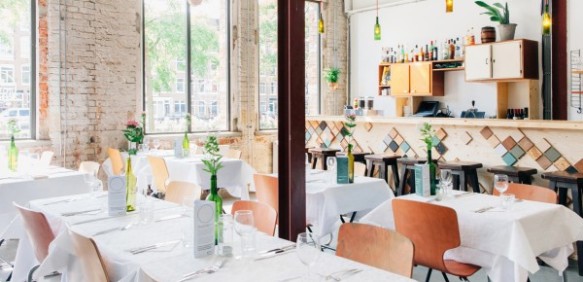
Instock was a pop-up restaurant where chefs will cook for five months with food that normally does not reach our plate. Because of the succes it opened it’s permanent locations.

Their mission? To reduce food waste! Selma, Merel, Bart and Freke met each at other at the Albert Heijn, one of supermarkets in the Netherlands. They became seperately interested in food waste with INSTOCK foundation as a result.

instock2

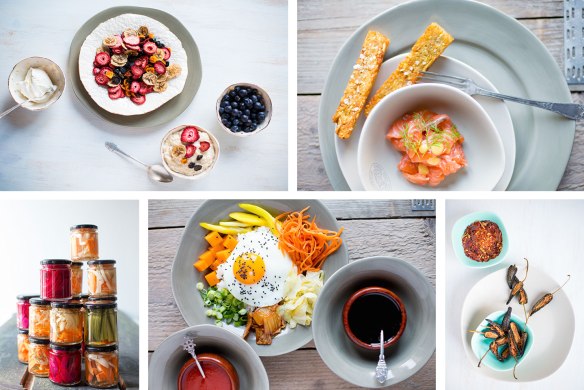
The first project was pop- up restaurant INSTOCK at the  Westergasterrein. The chefs use disapproved food and show that what would otherwise be discarded, is actually fantastic food. For €22,50 you can eat three courses. The procees will be used to support food related projects.

300316_Instock_kookboek_collage_2

Instock

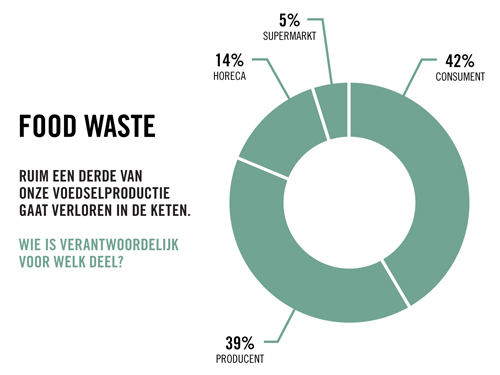
One-third of all our food is wasted. ‘We want to combat food waste and create awareness for the subject. We do this with our restaurant. And we also hope to contribute to raise awareness about food waste, in a fun and positive way! Because food is for you to enjoy. Over the past decades we took more and more distance from our food. We don’t need make a lot of effort, we have many choice, and food is plentiful in our western society. We hope to bring food closer. For example trough cooking workshops and fun events around food’ (Instock).

Food-Waste-Projectie

Instock

In the morning the ‘food rescue team’ of Instock passes by Albert Heijn strores in Amsterdam with their electric cars. Overthere they pick up food, that can no longer be sold. These products are by the way never beyond the date; it is for example bread from one day old or a of oranges that has one bad in it but the rest is still fine. At Instock guest are surprised with an ever- changing menu of inventive and tasty dishes.

Another post about the reeconomy will follow.


New ways to get energy

HM Coolhunt 5 – new ways to get energy

Over the past few years companies and people have been inventing new ways of generating electricity. Everyone is looking for fossil fuel alternatives. At this moment solar panels are still very expensive but they are becoming cheaper.

A team of developers from the Korean Advanced Institute of Science and Technology (KAIST) invented a small generator that can extract electricity from body temperature. A generator like this is not something new, but KAIST has made a version by which thermo electric substanceswere printed on fibre. Because of this, it is the first generator that is small enough to be incorporated into a smart watch. It’s also possible to bent the prototype. At this moment it’s still a prototype, so not for sale.

c4ee00242c-f6_630m

Another invention is to use plants as ‘biological solar panels’. Swiss designer Fabienne Felder has worked with University of Cambridge scientist Paolo Bombell to develop a way of using plants as a charger. Most people see moss as weeds.

During the photosynthesis process moss produces many so- called surplus (excess) electrons. Felder’s team captures these excess electrons, and uses them, in this case, to provide a radio from energy. So in this way they make a kind of organic solar panels from moss.

Worlds-first-moss-powered-radio_dezeen_6

The technique is not ideal yet, the radio can be used only a few minutes at this stage. But the technique is still in it’s early stages.

Another example is Plant-E. It’s a company from Wageningen, Holland. They are also busy with the technology to create energy from plants. In Zaandam, Holland, there will come a charging point for mobile phones, that is fed by a park. The company devised a system whereby plants generate electricity.

‘At this moment you pay 60.000 euro for 100 square meters from their system, but if their technology develops further their energy will also be available for the normal consumer’.

A different way of getting energy from nature is the inflatable wind turbine, the Buoyant Air Turbine. The system generates power at a high altitude (300 meters above the ground) and is therefore cheaper, more flexible and more efficient than existing wind turbines.

Conventional wind turbines are standing on high masts and have an average height of 100 meters. The problem is that the wind speed close to the ground fluctuates very often.

‘The company Altaeros has designed the BAT to generate consistently cheap electricity for rural areas and microgrids including remote communities and islanders, oil en gas industry, mining, agriculture, telecommunication companies, disaster reduction and military bases’, said a spokesman from the company.  (aandrijvenenbesturen)

altaeros-vliegende-windturbine

The BAT will, after an 18- month demonstration, be deployed on a site at the south of Fairbanks in Alaska.

Even more ideas were devised for the places where people have nothing and therefore don’t have the money for electricity. The Filipino entrepreneur and activist Illac Diaz has found a wonderful and inexpensive solution to enlighten dark spaces in slums, for example. The residents of these neighbourhoods often use kerosene candles or tapped electricity as a source of lighting with all safety risks of such.

Diaz uses as light source a transparant plastic soft drink bottle that is filled with water. Then the bottle will be affixed as a ceiling lamp, using glue and a roof covering plate. The water breaks the sunlight that shines into the bottle and spreads it in rays of 360 degrees, lighting the complete room. The solar bottle has become known as ‘liter of light’. It costs including maintenance are about one dollar and the lamp distributes a quantity of light similar to a light bulb of 55 wats.

GiftofLight-thumb-400x313-65196

The invention means a hughe saving on electricity, kerosene, candles or other fuel for the residents.

Diaz launched a succesful campaign in 2011 in which inhabitants of urban slums produced and installed the bottles themselves. Hundreds of people have been trained who earn money with installing the bottles. Tens ouf thousands solar bottles have been installed worldwide.

The bottle campaign started in the Philippines and has spread to India, Nepal, South America and Africa. The project ‘liter of light’ is conducted by the My Shelter Foundation.

Why is it cool?
Most of the time sustainability is about the over- use of energy. With the examples above, I was particularly pleased to see that there also are several new opportunities for the bottom layer of the population.

Because they now can see things again the dark, it’s safer for these people in slums in the evening. Also their days have become longer and they can better distribute their work. When energy will become cheaper for the slum dwellers, there can be done more technically and hopeflly also in a sustainable way!

Worldwide there are still hundreds of millions of people living in small structures in slums where they are exposed to risks due to the use of unsafe energy. Trough the new inventions it will be a lot safer there and they can work more efficiently.

Quality of Life

In the ‘category’ material wellbeing it has to do with all the categories (food, possessions, transport, privacy, housing quality, income, security). When the people in slums have more light and electricity they can work more efficient and earn more money, with more money they can eat, can have a roof above their head, have an income, they can have more possessions (although I think that they are already happy with the roof and food) but they also have more chance at more safety. This way of energy is a lot safer than the energy they are using at this moment.

And because of the safety it can also be assigned to ‘personal safety and mobility’. The unsafe use of energy creates accidents and it can cause that this has consequences for people’s health and mobility.

Thanks for reading!!

For more information check out these websites:
– http://www.bright.nl/opladen-met-lichaamswarmte-thermo-generator-smartwatch-elektrisch-oplader
– http://fullinsight.com/blog/2014/3/plant-e-living-plants-generating-electricity
– http://www.dezeen.com/2014/02/10/moss-biological-solar-panels-radio/
– http://freshgadgets.nl/deze-futuristische-machine-haalt-energie-uit-de-lucht
– http://www.aandrijvenenbesturen.nl/nieuws/algemeen/nid6888-opblaasbare-windturbine-zweeft-300-meter-boven-de-grond-video.html?printversie=1
– http://www.summer-foundation.org/nl/Initiatieven/Liter-of-Light
– http://freshgadgets.nl/lightie-een-innovatief-lampje-voor-ontwikkelingslanden

Coolhunt 5 – Against Global Warming

Sustainability is a long term trend and the past few years there have been invented new ways to deal with it. There are two trends I would like to share with you.

The first trend is about package waste. I already showed you a few cool things that are designed against food waste. In the past two years, there also have been invented products against packet waste.

The fast food firm ‘Bob’s’ came up with an edible wrapper. In the video below you can see that the people not only eat their burger but also eat the wrapper. It’s made from rice leaves and it tastes just like a normal burger.

There is also an ice cream shop, Coolhaus, that wraps it’s ice cream in edible paper.

lamixx31
The company ‘Monosol’ creates dissolvable packages for hot chocolate powder, oatmeal and other things. You can put the plastic into hot or cold water and it slowly dissapears.

Food package is a big part of the waste in our homes. Packings for the school lunch, or packages in the evenening during cooking. I’m always thinking about what can be done about this and the edible or dissolvable packages seem like a good solution to me.

At pinterest I have also seen a lot of pictures of nice ways to package your food, like eatable spoons or chocolate boxes.

Schermafbeelding 2014-03-17 om 21.26.28

The second trend is Urban Farming. I think everyone recognizes that title.

Anywhere in the western world, there have arisen vegetable gardens. At empty places in the city, in empty buildings or even on roofs. It’s also possible to make a vegetable table on balconies or even in the kitchen.
Urban farming has many advantages: it provides fresh and affordable fruit and vegetables. The city will become healthier and cleaner.

Schermafbeelding 2014-03-17 om 21.52.44Another example are the string gardens from Fedor van der Valk. It’s kind of the same as the Bonsai- technique where roots are growing in a ball of moss. You can hang the plants in your home. It’s a new way off gardening.

Schermafbeelding 2014-03-17 om 21.57.34

Why is it cool?
This year there were people who thought that there was a pause in the climate change. Since 2001 global warming has been slower than predicted. Research shows that the global warming hasn’t stopped in the past decade, but that the heat has been pushed below the surface because of the strong wind (Volkskrant, 2014)

This is why we still have to live more sustainable. It’s nice that they invent new ways to get people’s attention.

Why has it future growth potential?
An article in the Volkskrant says that the earth will heat up very quickly if the winds slow down in the coming years. The global warming hasn’t stopped and will not stop in the coming years. So everyone has to become more aware of it and the new inventions will help in this process.

Coolhunt 1 Against Food Waste

Today, we are producing too much food.
Research shows that around 5 to 10 per cent of the vegetables is being wasted because of their shape, color or size.

A few companies have developed a response to this process.

There is an older initative: ‘Kromkommer
They bring crazy vegetables – which will be wasted otherwise because of their shape, color, size or overproduction  – back into the food chain.

‘Kromkommer’ is also working on a production line. They connect farmers to wholesalers and horeca, and they are looking at possibilities to get crazy vegetables on the shelves.

krommunity-540x302

”There is not only the throwing away of a lot of vegetables, in Amerika they are discarding fifteen billion dollars of fruit every year” (Lindanieuws.nl) . Mirim Seo came up with a solution: Ugly Fruit. She is making jam, smoothies and dried fruit from the ‘ugly fruit’. She makes these products more attractive through pretty packaging.

klonblog-019-mirimseo

The restaurant Biomat let guests pay with waste.

BIOMAT was a POP-up restaurant in Austria. This restaurant offered meals in exhange for biodegradable waste. BIOMAT put the waste into biogas, which they used to cook with.
They asked their costumers to take bags with biodegradable goods with them to the restaurant. Then the bags were weighed and they got an energy value, which was converted into a voucher for the restaurant.

BIOMAT-Austrian-restaurant

Through the use of crowdfunding they are developing a product that gives you the opportunity to act against food waste yourself.
Within three hours the ‘Food Cylcer‘ turns food scraps into compost, which can be used, for example, in the vegetable garden.

foodcycler-compost-video 20140224071257-FCS_Lifestyle_9226_Mom_Child_Gardenand at last…

Around three weeks ago, the Albert Heijn (that’s a supermarket in Holland) gave away free transparent measuring cups with the purchase of a private label rice or pasta. With this, you can measure how much pasta or rice you need for a one to four persons portion. The article from the ‘Volkskrant’ (a dutch newspaper) mentioned that the measuring cup is difficult to read and that the dimensions are still different for every person. But they came to the conclusion that if the ‘Eetmaatje’ also let people who where never concerned about food waste, think about this dilemma, it was still useful.

foto

Why is it cool?
These initiatives and products ensure that more people are going to think about food waste.

Food waste is a big problem, it creates an inefficient use of energy and natural resources. There are still many people around the world who live with hunger every day and we are throwing food away?!!

I believe that these initiatives will improve the quality of life for people. People are now able to play a part in reducing food waste by themselves.

Within the model of Felce and Perry it will have a positive influence on our emotional well being. People are more satisfied and they are happy because they can do something for others.